 NEW YORK (CNNMoney.com)
If you're delinquent on your mortgage, your credit score will suffer. Everyone knows that. The question is, by how much?
Until recently, those answers were hard to come by. Credit bureaus were uncommunicative about expressing, in points, just how much impact different foreclosure types of mortgage delinquencies have on scores.
Recently, Fair Isaac, which developed FICO scores, pulled back the curtain a bit, revealing some estimates of point-score declines following mortgage delinquency problems.
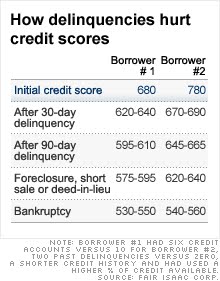
Here are the average hit your credit will take:
30 days late: 40 - 110 points
90 days late: 70 - 135 points
Foreclosure, short sale or deed-in-lieu: 85 - 160
Bankruptcy: 130 - 240
To come to these figures, Fair Isaac created two hypothetical consumers, one who starts out with a fair-to-middling score of 680 and the other with a very good one of 780. (FICO scores range from 300 to 850.)
The hypothetical person with the 780 FICO has 10 credit accounts versus six for the 580, plus a longer credit history, lower utilization of total credit limit and no missed payments on any account. The other consumer has two slightly damaged accounts. Neither have any accounts in collection or adverse public records.
(See the chart above to see how each scenario affected each borrower)
Notice that for both borrowers a single one-time black mark results in steep drops, but it is when they fall further behind that things get really harsh, according to Craig Watts, a spokesman for Fair Isaac.
"The lending industry tends to regard an account differently when it has become 90 or more days late," he said, "The likelihood that consumers will resume paying their overdue obligations drops off significantly after the delinquencies have reached 90 days."
One reason credit companies were so closed-mouthed is that they often can't definitively state how much each delinquencies will affect scores because there are too many variables.
Some borrowers will fall much more steeply than others for the same payment problem, according to Maxine Sweet, vice president for public education at Experian, one of the nation's main credit bureaus.
"If you picture someone who has just one mortgage and one other credit account versus a mature credit user like me with 15 accounts, if they miss one payment that would impact their scores a lot more," she said. "For me, one missed payment would just be a blip."
The point loss also depends on the borrower's starting point: People with very high credit scores have more to lose than low-score borrowers; the impact of a single blemish on an 800 score is more than on a 500.
Of course, it just gets worse when you face foreclosure.
Mortgage borrowers can lose their homes three basic ways: a foreclosure; a short sale, where the home is sold for less than than is owed and the bank (generally) forgives the difference; or a deed-in-lieu, in which the borrower gives back the property and the bank again forgives any unpaid balance.
Sweet said credit bureaus generally slash scores equally for those three resolutions to someone losing their home. The important factor, she said, is that "it's reported that you paid less on a settled account."
Some borrowers may think that because they never missed a payment, they can "walk away" from their homes with relatively little impact on scores. Not true. "When a deed-in-lieu or short sale is reported as a partial payment, it's treated as a serious delinquency," Watts said, "just like a foreclosure."
Even if borrowers made payments faithfully for years before short selling or doing a deed-in-lieu, their credit score will still take a hit. The total decline will run about 85 points for the 680 score borrower to as much as 160 for the 780 score.
Mortgage debt, combined with other financial problems, can send borrowers into bankruptcy, the worst thing that can happen to your credit score.
The effects are long-lasting, according to Sweet. In a Chapter 13 bankruptcy, which involves partial repayment over several years, the stain will take seven years to remove. A Chapter 7 bankruptcy, which involves liquidation, takes 10 years to get over.
Until recently, those answers were hard to come by. Credit bureaus were uncommunicative about expressing, in points, just how much impact different foreclosure types of mortgage delinquencies have on scores.
Recently, Fair Isaac, which developed FICO scores, pulled back the curtain a bit, revealing some estimates of point-score declines following mortgage delinquency problems.
Here are the average hit your credit will take:
30 days late: 40 - 110 points
90 days late: 70 - 135 points
Foreclosure, short sale or deed-in-lieu: 85 - 160
Bankruptcy: 130 - 240
To come to these figures, Fair Isaac created two hypothetical consumers, one who starts out with a fair-to-middling score of 680 and the other with a very good one of 780. (FICO scores range from 300 to 850.)
The hypothetical person with the 780 FICO has 10 credit accounts versus six for the 580, plus a longer credit history, lower utilization of total credit limit and no missed payments on any account. The other consumer has two slightly damaged accounts. Neither have any accounts in collection or adverse public records.
(See the chart above to see how each scenario affected each borrower)
Notice that for both borrowers a single one-time black mark results in steep drops, but it is when they fall further behind that things get really harsh, according to Craig Watts, a spokesman for Fair Isaac.
"The lending industry tends to regard an account differently when it has become 90 or more days late," he said, "The likelihood that consumers will resume paying their overdue obligations drops off significantly after the delinquencies have reached 90 days."
One reason credit companies were so closed-mouthed is that they often can't definitively state how much each delinquencies will affect scores because there are too many variables.
Some borrowers will fall much more steeply than others for the same payment problem, according to Maxine Sweet, vice president for public education at Experian, one of the nation's main credit bureaus.
"If you picture someone who has just one mortgage and one other credit account versus a mature credit user like me with 15 accounts, if they miss one payment that would impact their scores a lot more," she said. "For me, one missed payment would just be a blip."
The point loss also depends on the borrower's starting point: People with very high credit scores have more to lose than low-score borrowers; the impact of a single blemish on an 800 score is more than on a 500.
Of course, it just gets worse when you face foreclosure.
Mortgage borrowers can lose their homes three basic ways: a foreclosure; a short sale, where the home is sold for less than than is owed and the bank (generally) forgives the difference; or a deed-in-lieu, in which the borrower gives back the property and the bank again forgives any unpaid balance.
Sweet said credit bureaus generally slash scores equally for those three resolutions to someone losing their home. The important factor, she said, is that "it's reported that you paid less on a settled account."
Some borrowers may think that because they never missed a payment, they can "walk away" from their homes with relatively little impact on scores. Not true. "When a deed-in-lieu or short sale is reported as a partial payment, it's treated as a serious delinquency," Watts said, "just like a foreclosure."
Even if borrowers made payments faithfully for years before short selling or doing a deed-in-lieu, their credit score will still take a hit. The total decline will run about 85 points for the 680 score borrower to as much as 160 for the 780 score.
Mortgage debt, combined with other financial problems, can send borrowers into bankruptcy, the worst thing that can happen to your credit score.
The effects are long-lasting, according to Sweet. In a Chapter 13 bankruptcy, which involves partial repayment over several years, the stain will take seven years to remove. A Chapter 7 bankruptcy, which involves liquidation, takes 10 years to get over.
It's gonna cost you
Absorbing a big credit-score hit can make many transactions more costly. It's not just paying more for credit card debt and auto loans, insurance can cost more as well.
The average savings for someone with a good versus mediocre credit score is about $115 a year for auto insurance and $60 for home, according to Loretta Sorters, of the Insurance Information Institute.
A low credit score can even make it harder to rent a home because landlords often use credit scores to weed out prospective renters.
Despite the problems a poor credit score can cause, Experian's Sweet recommends that people who are in financial dead ends, like totally unaffordable mortgages, it's better to recognize that and cut your losses quickly; don't prolong the problem.
"You need to do what you need to do to get your finances back in order," she said. "Don't worry about your credit score."


